


Description: The ADT 7100 is a semi-automatic, high-precision dicing saw used for cutting delicate and hard materials in semiconductor, microelectronics, and advanced R&D environments. It is a versatile “workhorse” tool optimized for tight-tolerance, multi-angle dicing of various substrates.
Features:
- Operation: The system offers both automated and manual cutting modes, allowing for flexibility in processing different types of workpieces.
- Spindle: It is typically equipped with a 2-inch, DC-brushless, air-bearing spindle that can reach speeds up to 60,000 RPM (60 krpm) for precise, low-vibration cutting.
- Precision and Resolution: The ADT 7100 boasts high accuracy, with a resolution of 0.2 µm and precision down to a few microns for alignment to on-wafer features.
- Substrate Compatibility: It can handle various substrate sizes, generally up to 8 inches (200 mm) in diameter, and can process materials mounted to UV-release tape.
- Programmability: The saw is fully programmable and controlled by a computer system that allows for complex cut maps, including multiple indices and varying cut depths.
- Vision System: It includes a digital camera vision system with high-bright LED illumination for accurate alignment and real-time viewing of the cutting process.
Applications
The ADT 7100 is used for dicing a wide array of materials into smaller component pieces:
- Silicon wafers
- Glass (fused silica, borosilicate glass)
- Sapphire and silicon carbide
- Ceramic substrates (alumina, hybrids, LTCC)
- Plastics and composite materials
- Opto-electronic components and sensors
- PCB, QFN, and BGA panels
Description: The DISCO DAD 3240 is a compact, automatic dicing saw used for high-precision cutting (singulation) of semiconductor wafers and other hard materials into individual dies or chips. It is widely used in microfabrication facilities and R&D labs due to its small footprint and versatility.
Features:
- Operation: The system offers both automatic and semi-automatic modes via an intuitive 15-inch LCD touch panel and Graphical User Interface (GUI). It features an automatic alignment function for precise cuts.
- Capacity: It is designed to handle workpieces up to 8 inches (200 mm) in diameter, accommodating both circular and rectangular pieces mounted on dicing tape and frames.
- Spindle: A high-output 1.8 kW air-bearing spindle provides variable rotation speeds from 6,000 to 60,000 RPM, enabling efficient processing of a wide range of materials.
- Precision: The saw offers high indexing accuracy, with a minimum Y-axis index step of 0.0001 mm (0.1 µm).
- Footprint: The DAD 3240 is noted for its world-class smallest footprint for an 8-inch compatible saw, making it suitable for cleanrooms with limited space.
- Built-in Diagnostics: It features integrated monitoring systems, such as a blade breakage detector and scope blow function to reduce maintenance frequency.
Applications:
The DAD 3240 is a versatile tool used for dicing a wide array of materials:
- Semiconductor Wafers: Silicon, Gallium Arsenide (GaAs), Gallium Nitride (GaN), and related III-V materials.
- Hard Materials: Ceramics (alumina), sapphire, quartz, and various glasses (Pyrex, fused silica).
- Research & Prototyping: Used in academic and industrial settings for developing micro-ultrasound probes, photonics devices, and general micro-electro-mechanical systems (MEMS).
- Operation typically requires samples to be mounted on dicing tape to ensure secure vacuum chucking during the cutting process.


Description: The Strasbaugh 6EC is an economical, semi-automatic Chemical Mechanical Planarization (CMP) system designed for research and development (R&D), failure analysis, and low-volume production in semiconductor and micro-electromechanical systems (MEMS) applications.
The 6EC uses a combination of chemical processes (slurry) and mechanical polishing (pad rotation and downforce) to remove material and achieve a globally flat (planarized) surface on a substrate. This is essential for advanced integrated circuits to enable subsequent lithography steps with high depth of focus (DOF) requirements.
Features:
- Semi-Automatic Operation: Processes are programmable via a color, touch-screen graphical user interface (GUI) for repeatable and accurate process control, while typically requiring manual wafer loading/unloading.
- Wafer Compatibility: The system can accommodate various wafer sizes, typically ranging from 4-inch, 6-inch, and up to 8-inch (200 mm) diameter wafers, as well as square samples.
- Precision Control: It utilizes closed-loop motors for table and spindle drives, which helps ensure consistent process results. The system allows for programmable down pressure and variable rotation speeds (up to 185 rpm for the table).
- Pad Conditioning: A programmable pad conditioning system (using a diamond-plated disk or nylon brush) is included to maintain consistent removal rates and optimize within-wafer non-uniformity (WIWNU).
- Advanced Wafer Handling: The system uses a VIPRR (Variable Internal Pressure Retaining Ring) carrier and a Hydro-Lift Load Station to minimize contamination and deliver superior center-to-edge uniformity.
- Compact Footprint: Its relatively small size makes it suitable for research labs or cleanrooms with limited space.
Applications
The Strasbaugh 6EC is versatile and used for polishing various thin films on substrates, including:
- Dielectric Planarization: Removing thin layers of silicon dioxide for device and circuit planarization.
- Shallow Trench Isolation (STI): Creating isolating structures in semiconductors.
- Metal Damascene Processes: Polishing off excessive metals like copper or tungsten during multi-level metallization schemes.
- MEMS Fabrication: Polishing alternating layers of polysilicon and oxide for micro-electromechanical systems with large topography.
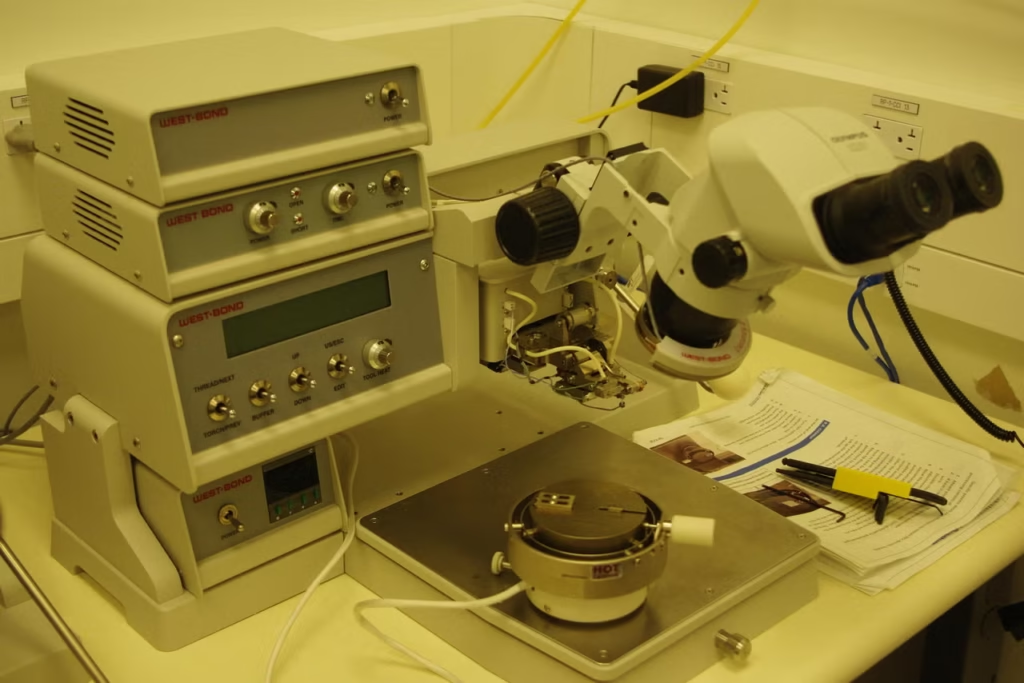
Description: The Westbond 747677E is a versatile, manual, and “triple convertible” wire bonding tool used for making electrical interconnections in semiconductor, hybrid, microwave, or MEMS devices. It is designed to be easily configured for different bonding methods and wire types, making it a flexible instrument for research and low-volume production environments.
Features:
- Convertible Bonding Methods: The key feature is its ability to perform three different bonding types with simple assembly exchanges:
- 45° Wedge Bonding: The standard method for wedge bonding.
- 90° Deep Access Wedge Bonding: Used for accessing deep packages or substrates.
- Ball Bonding: For use with gold wire where a ball is formed before the first bond.
- Bonding Mechanism: The system primarily uses a combination of ultrasonic energy (at 63 kHz) and force to create the bond. For gold wire bonding (thermosonic bonding), heat is applied to the workholder or tool to facilitate the bond.
- Manual Control: Operation is manual, guided by an 8:1 reduction ratio micromanipulator arm, providing the operator with fine control and tactile feedback for precise bond placement.
- Wire Compatibility: It is compatible with a range of aluminum (Al) and gold (Au) wires or ribbons, typically from 0.7 mil to 2 mil (0.0007″ to 0.002″) in diameter.
- Programmable Parameters: Although manual in operation, the system allows for the programming of bond parameters like ultrasonic power, time, and force, which helps in achieving consistent and repeatable results.
- Heated Workholder: Multiple heated workholders are available, capable of reaching temperatures up to 400 °C, which is essential for thermosonic bonding.
Applications
The Westbond 747677E is widely utilized in microfabrication and packaging labs for:
- Prototyping: Rapid iteration of device designs due to its manual, flexible nature.
- R&D: Academic and industrial research environments where versatility is more important than high-volume throughput.
- Hybrid & Microwave Devices: Interconnecting components in complex electronic packages.
- MEMS Fabrication: Creating electrical connections for micro-electromechanical systems.
Leave a Reply