


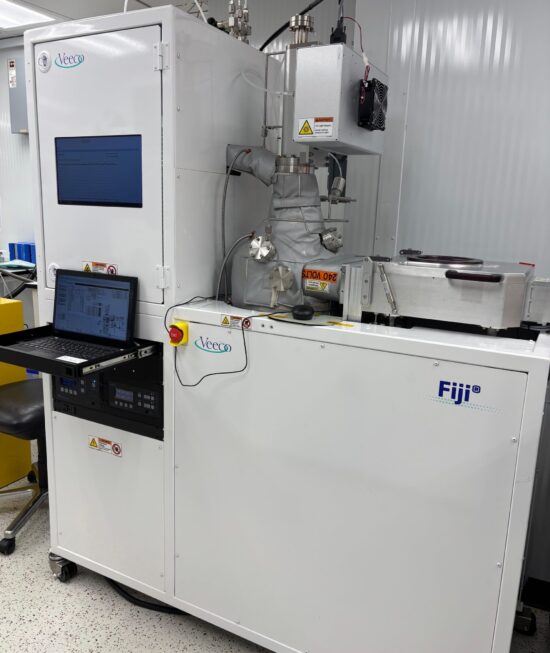
Tool: Atomic Layer Deposition (ALD), Veeco Fiji
Description: The Veeco Fiji is a modular Atomic Layer Deposition (ALD) system designed for advanced thin film research. It supports thermal ALD, plasma-enhanced ALD (PEALD), and Exposure Mode™, providing exceptional flexibility for depositing conformal films on flat or high-aspect-ratio structures. With precise thickness control, excellent uniformity, and compatibility with a wide range of precursors and gases, the Fiji is widely used in semiconductor, MEMS, sensor, energy, and 2D materials research.
Features:
- Material: Al2O3, HfO2
- Process temperature: Up to 500°C for 200mm substrates (800°C optional for 100mm)
- Plasma source: 300W inductively coupled plasma (ICP) source
- Deposition uniformity:
- ±1.5%plus or minus 1.5 %
- ±1.5% for thermal and plasma Al2O3 (1 sigma)
- Precursor handling: Up to 6 precursor lines, individually heatable to 200°C, supporting gas, liquid, and solid precursors
- Plasma gas lines: Up to 6 lines with support for Ar, N2, O2, H2, and ozone
- Film thickness control: Angstrom-level resolution
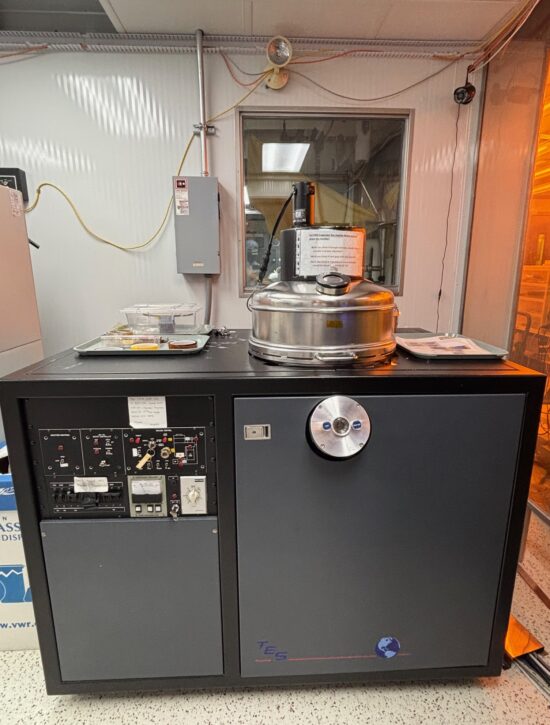
Tool: Ebeam evaporator, BJD1800
Description: The Temescal BJD-1800 is an industry-proven, low-profile, bell jar type electron-beam (E-beam) evaporator system used for thin metal film deposition in research and development and production applications. It is widely used for optical and electronic coating processes.
Features:
- Function: Physical Vapor Deposition (PVD) system, primarily configured as an E-beam evaporator, but can also be configured for thermal evaporation or sputtering.
- Chamber: An 18-inch (457 mm) diameter, water-cooled stainless steel chamber with a hinged, spring-loaded dome for easy access and substrate loading.
- Vacuum System: Typically uses a CTI Cryo-Torr 8 cryogenic pump to achieve a high vacuum environment, with base pressures in the low 10⁻⁷ to 10⁻⁸ Torr range, supported by a mechanical roughing pump.
- E-Beam Source: Features a multi-pocket (commonly 4- or 6-pocket) rotating hearth electron gun, which allows for the sequential deposition of different materials without breaking the vacuum.
- Materials: Can be used to deposit a wide variety of materials, including Aluminum (Al), Titanium (Ti), Gold (Au), Chromium (Cr), and Silicon (Si).
- Control: Systems are often equipped with automated process control, including deposition controllers (e.g., Inficon I/C5 or XTC/2) for precise control over deposition rate and film thickness, and programmable sweep controllers.
- Substrate Handling: Accommodates various substrate sizes up to 6-inch wafers, with available planar and planetary rotation options for uniform coating.
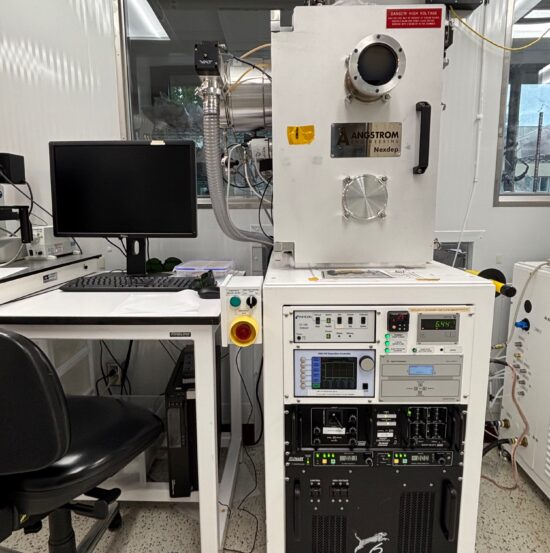
Tool: Ebeam evaporator, Nexdep
Description: The Angstrom Nexdep is a Physical Vapor Deposition (PVD) system used for creating thin films through processes like thermal evaporation or electron beam evaporation. It is a flexible and configurable tool for research and development, known for its user-friendly, automated control of deposition processes, and can be combined with a glovebox for a controlled atmosphere. The system can handle large substrates and process multiple materials in a single cycle.
Features:
- Flexible configuration: an e-beam source with multiple pockets
- Automated control: Features automated vacuum operations and deposition rate control, with PC control for recipe building and data logging.
- Substrate handling: Supports a variety of substrate sizes and offers options like heating
- Multi-layer deposition: Can deposit multiple layers of different materials in a single pump-down cycle.
- Materials: Capable of depositing a wide range of materials, including Aluminum (Al), Titanium (Ti), Gold (Au), Chromium (Cr), and Silicon (Si).
Tool: Sputtering, Angstrom Amod
Description: The Temescal BJD-1800 is an industry-proven, low-profile, bell jar type electron-beam (E-beam) evaporator system used for thin metal film deposition in research and development and production applications. It is widely used for optical and electronic coating processes.
Features:
- Function: Physical Vapor Deposition (PVD) system, primarily configured as an E-beam evaporator, but can also be configured for thermal evaporation or sputtering.
- Chamber: An 18-inch (457 mm) diameter, water-cooled stainless steel chamber with a hinged, spring-loaded dome for easy access and substrate loading.
- Vacuum System: Typically uses a CTI Cryo-Torr 8 cryogenic pump to achieve a high vacuum environment, with base pressures in the low 10⁻⁷ to 10⁻⁸ Torr range, supported by a mechanical roughing pump.
- E-Beam Source: Features a multi-pocket (commonly 4- or 6-pocket) rotating hearth electron gun, which allows for the sequential deposition of different materials without breaking the vacuum.
- Materials: Can be used to deposit a wide variety of materials, including Aluminum (Al), Titanium (Ti), Gold (Au), Chromium (Cr), and Silicon (Si).
- Control: Systems are often equipped with automated process control, including deposition controllers (e.g., Inficon I/C5 or XTC/2) for precise control over deposition rate and film thickness, and programmable sweep controllers.
- Substrate Handling: Accommodates various substrate sizes up to 6-inch wafers, with available planar and planetary rotation options for uniform coating.
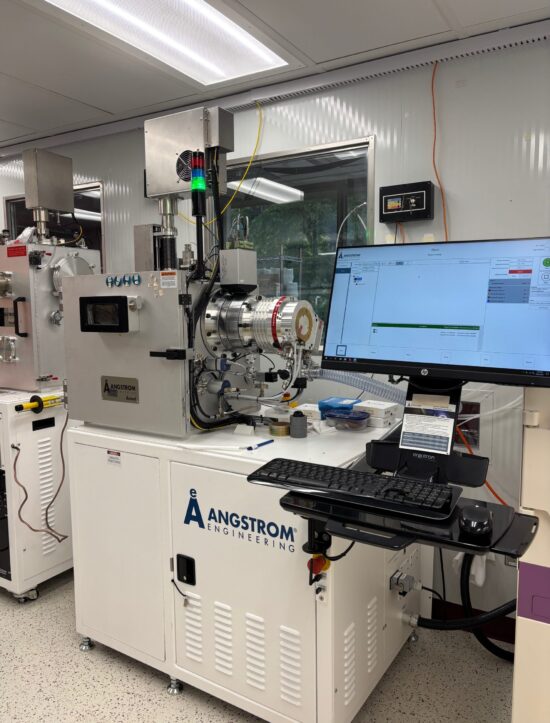

Tool: Sputtering, Denton Desktop Pro
Description: The Denton Desktop Pro is a compact, high-vacuum magnetron sputtering system designed for R&D, offering versatility for depositing metals, dielectrics, and magnetic films with excellent uniformity, featuring DC & RF sputtering, short pump-downs, and a small footprint (under 36″ wide) for research labs needing consistent, high-quality thin-film coatings.
Features:
- Compact Design: Fits on a standard workbench, requiring less than 36 inches of space.
- Versatile Sputtering: Supports both DC (for metals, magnetic materials) and RF (for dielectrics, reactive sputtering) power supplies.
- High Vacuum: Achieves high vacuum levels (10⁻⁶ Torr range) with fast pump-down times.
- Uniformity: Utilizes inclined magnetrons and rotating substrate stages for films with thickness within 5% across the substrate.
- Co-Sputtering: Capable of depositing multiple materials simultaneously for complex alloys.
- Research-Focused: Ideal for SEM sample prep (like gold coating), R&D, and producing functional thin films.
Tool: Plasma Enhance CVD
Description: The Oxford PlasmaLab 100 PECVD (Plasma-Enhanced Chemical Vapor Deposition) is a versatile, modular system for depositing high-quality thin films like silicon dioxide (SiO2), silicon nitride (SiNx), and amorphous silicon (a-Si) at low temperatures, using plasma energy to activate chemical reactions for semiconductor manufacturing, MEMS, and optical coatings. It utilizes RF/LF power, various gases (like silane, nitrogen, nitrous oxide), and features precise control for uniform, low-stress films.
Features:
- Low-Temperature Deposition: Plasma provides energy for reactions, allowing deposition below traditional thermal CVD temperatures (e.g., 350°C).
- Material Versatility: Deposits dielectrics (SiO2, SiNx, SiON), amorphous silicon (a-Si), and sometimes SiC.
- Modular Design: Can be configured with loadlocks and transfer chambers for automated handling, often paired with ALD tools.
- Plasma Generation: Uses RF (13.56 MHz) and LF (50-460 kHz) power for plasma, offering stress control.
- Gas Handling: Accommodates precursors like silane (4), ammonia (3), nitrogen (2), and nitrous oxide (2).
Common Applications
- Dielectric Layers: Gate dielectrics, isolation layers, capacitor films.
- Protective Coatings: Hard masks, passivation layers, anti-reflective coatings.
- MEMS: Sacrificial layers, structural materials for Micro-Electro-Mechanical Systems.
Typical Operating Conditions
- Substrate Temperature: Room temp up to ~400°C.
- Process Pressure: Typically 600-1200 mTorr.


Tool: Plasma Enhance CVD
Description: The Applied Materials (AM) Precision 5000 (P5000) is a legacy semiconductor processing system, typically configured as a cluster tool with multiple chambers for various processes, including Plasma-Enhanced Chemical Vapor Deposition (PECVD). The specific technical specifications depend heavily on its exact configuration, which varies by the owner and application.
Features:
- Multi-Chamber Architecture: The core innovation of the P5000 was its automated, multi-chamber design. This architecture allowed different processes (e.g., deposition and etchback) to be performed on the same wafer in a single, continuous system under vacuum, improving efficiency and flexibility.
- Process Versatility: The system is highly customizable and can accommodate various deposition and etch techniques, including atomic layer deposition (ALD), physical vapor deposition (PVD), and chemical vapor deposition (CVD). It was used for processes like blanket tungsten deposition and integrated tungsten plug fabrication.
- Precise Control: The P5000 features advanced sensors (mass flow controllers, pressure transducers, temperature probes) and computer controls, enabling precise monitoring and control of process parameters such as temperature, gas flow rate, and chamber pressure.
- Substrate Compatibility: It can process various substrate materials, including silicon, glass, and quartz, typically up to 6 or 8 inches in diameter, depending on the specific configuration.
- Legacy: The P5000 platform’s success led to the development of subsequent, more advanced platforms like the Producer® and Centura® systems, which built upon its modular, integrated processing legacy.
Leave a Reply