


Why Micro-Lenses Matter
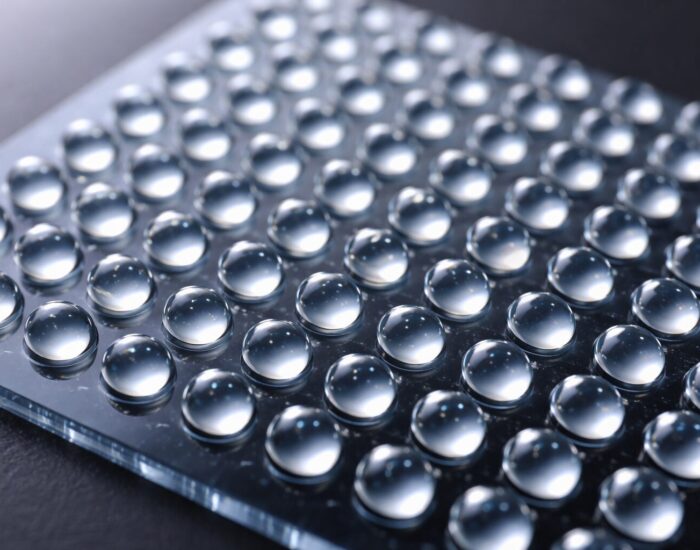
Micro-lenses are foundational components in modern optical and optoelectronic systems. As devices become smaller, faster, and more energy-efficient, precise control of light at the micro-scale is no longer optional—it is essential.
1.Higher Optical Efficiency
Micro-lenses significantly improve how light is extracted, focused, and directed. By reducing optical losses due to reflection and divergence, they enable brighter displays, higher sensitivity sensors, and lower power consumption.
Impact: Micro-LED displays • LEDs • Optical detectors • Imaging sensors
2.Miniaturization & Integration
By fabricating micro-lenses directly on functional substrates, bulky external optics are eliminated. This enables monolithic integration, improving alignment accuracy, reliability, and mechanical robustness.
Impact: Wearables • Compact cameras • Photonic integrated circuits • Lab-on-chip systems
3.Precision Light Control
Micro-lens arrays enable beam shaping, collimation, and angular emission control at the device level. This precision is critical for uniform illumination and controlled light distribution.
Impact: AR/VR displays • Projection systems • Laser beam shaping • Optical coupling
4.Enhanced Sensing & Imaging
In imaging and sensing systems, micro-lenses increase light collection efficiency and enable parallel optical channels, improving resolution and signal-to-noise ratio in compact form factors.
Impact: CMOS image sensors • LiDAR (Light detection and ranging) • Biomedical diagnostics • Environmental sensors
5.Enabling High-Speed Photonics
Micro-lenses improve coupling efficiency between light sources, waveguides, and fibers, reducing optical losses and enabling high-bandwidth, low-energy photonic systems.
Impact: Wearables • Compact cameras • Photonic integrated circuits • Lab-on-chip systems
6.Miniaturization & Integration
By fabricating micro-lenses directly on functional substrates, bulky external optics are eliminated. This enables monolithic integration, improving alignment accuracy, reliability, and mechanical robustness.
Impact: Optical interconnects • Data centers • Integrated photonics • Optical communications
7.Application-Driven Customization
Different applications demand different optical behaviors. Custom-designed micro-lenses allow performance to be tailored for wavelength, focal length, numerical aperture, and emission profile.
Impact: Micro-LEDs • UV/visible/NIR optics • Specialized R&D platforms
Micro-Lenses at Micro to Nano Solutions
At Micro to Nano Solutions (M2N), we develop micro-lens technologies designed to meet real-world performance requirements—bridging fundamental optics with scalable micro-fabrication.
Our intellectual property portfolio focuses on the realization of customized micro-lens arrays and single-lens structures fabricated directly on sapphire, bulk GaN, silica (SiO₂), and silicon nitride (SiNₓ) substrates, enabling monolithic integration with active and passive photonic devices.
To-date, micro-lenses, a multi-functional optical element, can be fabricated using several established and emerging approaches, including:
- ink jet printing,
- grayscale lithography
- direct laser writing,
- nanoimprint lithography,
- photoresist thermal reflow, and etch-based surface shaping, etc.
Each method offers distinct advantages in terms of lens profile control, scalability, cost, and substrate compatibility. M2N has evaluated and optimized these approaches to address the diverse requirements of research and early-stage production environments.
At M2N, our core and proprietary process is based on photoresist thermal reflow followed by inductively coupled plasma (ICP) dry etching.
In this approach,
- precisely patterned photoresist features are thermally reflowed to form smooth, near-ideal spherical or aspherical lens profiles driven by surface tension.
- These profiles are then faithfully transferred into the underlying substrate using optimized ICP etching chemistries, enabling excellent control of lens geometry, surface roughness, and etch selectivity across a wide range of optical materials.
This etch-transfer method enables micro-lens fabrication on hard and optically functional substrates such as sapphire and GaN, where direct reflow or imprint techniques are not feasible.
The resulting lenses exhibit low optical scattering, high surface quality, and excellent dimensional uniformity, making them suitable for demanding applications in the UV, visible, and near-infrared regimes.
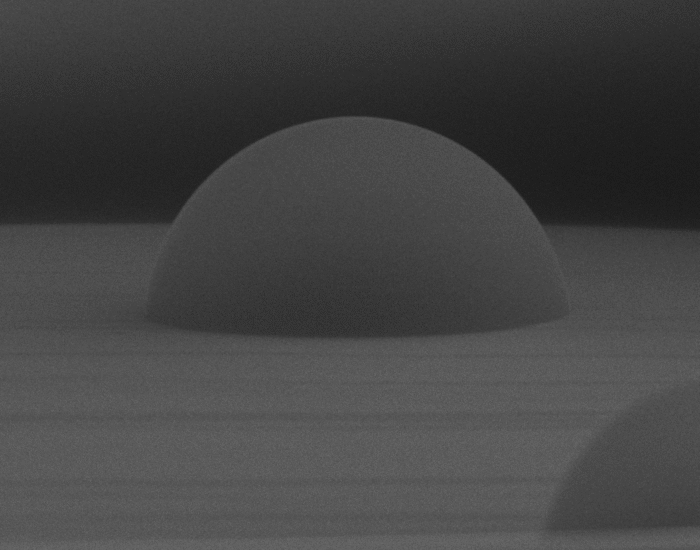
A defining feature of the M2N micro-lens IP portfolio is design flexibility and application-driven customization. Lens diameter, sag height, focal length, numerical aperture, and array layout can be tailored to customer-specific performance targets, including light extraction enhancement, beam shaping, optical coupling efficiency, and angular emission control.
This adaptability enables deployment across a broad range of applications such as micro-LEDs and LEDs, photonic integrated circuits, optical sensors, imaging systems, and laser-based platforms.
Through the combination of process know-how, material compatibility, and scalable fabrication, MNS provides a robust and customizable micro-optical technology platform that bridges early-stage R&D and small-volume production.